Completed NEA

 Dear Moderator,

My name is Lacey Vanner. Welcome to my A Level Media Studies blog. This is a record of the work I have undertaken for the Making Media Non-examination Assessment (NEA) within the OCR H409 GCE A Level course in Media Studies.

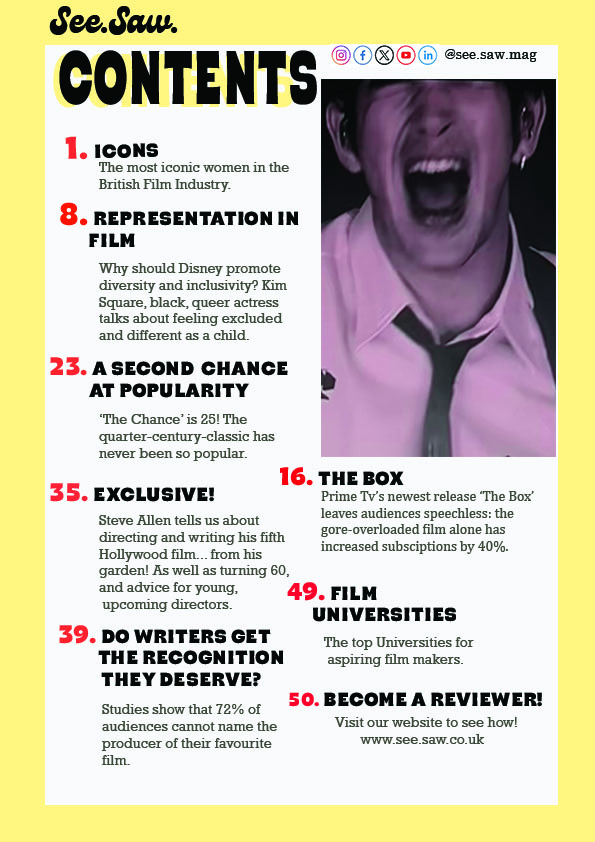
I worked independently on Brief 3: Magazine and Online to produce the front covers and contents pages for the first editions of the film magazine called 'See.Saw.' together with the magazines accompanying website.

Research and Planning:

Further down in my blog you will find evidence of my research and planning for this task.

Magazine covers and Contents pages:

Magazine first edition cover and contents pages


Magazine second edition cover and contents pages


Accompanying website for See. Saw magazine can be found here.


NEA Task 16 (Planning) : Masthead Design


 'The Bold Font'.

'Genty' font

'Captoon' font. 


I chosen to combine the Genty font for See.Saw.'s masthead, accompanied by the strap line, 'UNCOVERING ALL THINGS FILM.' in the Captoon font. The copy on the front cover of my magazine will also be in this font. 

NEA Task 12 : Research Into Film Magazine Contents Pages


Sight and Sound contents pages
 
                                                       
                                                           Film Stories contents pages


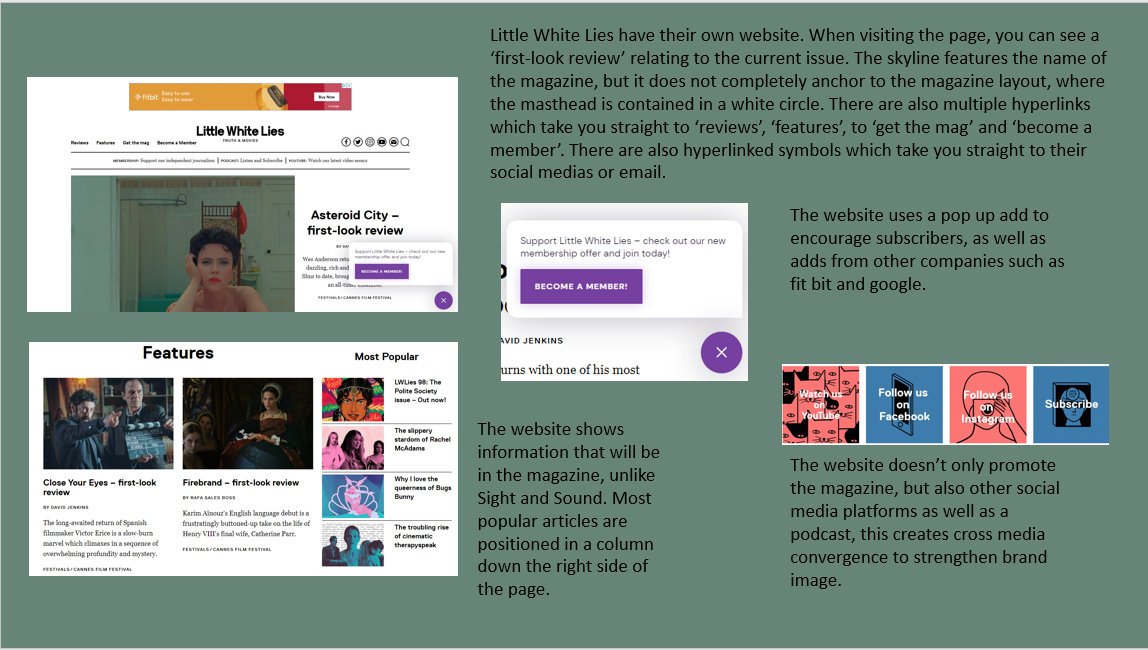
                                                           Little White Lies contents page


Both Little White Lies and Sight and Sound only have a single contents page, whereas Film Stories have a double contents page to show what is to come throughout the issue.

Sight and sound display their contents in a black and white minimal, table-like structure where readers can easily distinguish where to find specific topics like 'reviews' and 'this month'. Both content pages display 3 images down the right hand column showing 'contributors', also in black and white. All subtitles are capitalised, but the regular copy isn't and all copy is sans-serif throughout.

Little White Lies display their contents in 2-3 columns (which is as a whole) is referred to as 'FEATURE CONTENTS', as well as copy stating what issue the audience is reading, also capitalised. Each section of content is titled in bold sans-serif font. Little White Lies uses no images, but instead each issue's background is edited to anchor the colour palette on the front page. 

Film Stories display their contents across two pages with two columns of copy on both the far left and right hand sides of each page. Sections often featured include 'credits' and 'the important people'. Images are rather predominant across Film Stories pages, with 4 large polaroid-esque images accompanied by capitalised copy below related to the topic. The overall copy throughout the contents pages is sans serif.

All three contents pages use page numbers to guide readers on how to find a specific topic within that column. Only Sight and sound use black and white ink and altered text direction, Little White Lies is the only magazine (of the 3) who do not feature images in their contents page. Film Stories only display page number references on the far right, whereas the other two display theirs's centred on the page. 


NEA Task 11 : Research Textual Analysis of Film Stories Front Covers


NEA Task 8 : Research Into Existing Film Magazines For A Media Literate Audience

 'Sam' (a member of a media literate audience) is likely to engage in film magazines like Sight and Sound, Little White Lies and Film Stories. 

Film Stories is a film magazine founded by Simon Brew and was launched in 2018 as a Uk monthly film magazine. Issues vary from £3.99 to £5.99 a piece, or a yearly subscription can be bought for just £29. Film Stories has a website where audiences can subscribe to newsletters and engage with hyperlinks such as podcasts and live events. 

Little White Lies is a print magazine published bi-monthly by The Church of London from 2005. Little White Lies has been described as “at the vanguard of the independent publishing movement.” The magazine can be bought from the website for £28.00, which includes all five copies in once yearly subscription. 
Sight and Sound is published by the British Film Institute since 1932, there is a new copy of the magazine monthly, and is also available to view in digital format. An annual print subscription is £50, whereas a print subscription is just £35. The film magazine does not have a website, but is featured on the British Institute website. 


NEA Task 7 : My Target Audience

 Establishing their target audience is important to Bauer, their website states that 'We are guided by regular research and analysis of our markets and target group, which allows us to understand our readers, users, listeners, and advertisers and know exactly how to engage, inform and entertain'. As a commercially driven organisation, Bauer need to ensure their product is created for the correct audience. 

The target audience for my magazine/website are a primarily 16-25 tear old middle and upmarket media literate audience. 

The core concept of media literacy is intelligent engagement with media and technology as both a user and creator. A media literate person can actively decode, evaluate, analyse and produce media independently. They recognize different perspectives and think critically and become smarter consumers as they deeply understand content and the producers intentions. To be media literate, you can confidently respond to media texts in an active, engaging way instead of just becoming accepting. 

Target Audience Profile

Sam may be in the Sixth Form studying A Levels and preparations for university. If Sam is already at university they are likely to be studying at a Russell Group university and following a course that is recognised as being traditionally academic. If Sam is employed they may be at the start of their career and, therefore, not at the height of their earning potential yet.

Sam’s family background will have added significant cultural capital to their experiences. Sam will have been brought up in a household where there has been a clear focus on the importance of education and the opportunities that this can bring. Sam will have experienced holidays both in this country and abroad and their knowledge of other cultures will have been enhanced by this.

Sam is knowledgeable about current affairs but doesn’t access news via traditional channels such as newspapers or television. Sam would not dream of reading the red top or middle-market tabloids. If Sam had to, they may flick through The Guardian or i. 

To keep updated on what is happening in the world Sam, like most others of their age, relies more heavily on their social media feeds. Social media is important to Sam but it doesn’t dominate their life. They are more likely to use Instagram and Tik Tok than Facebook and will be as interested in consuming as they are in producing content. Sam likes to be seen as slightly different to the average 16-25 year old and has an active interest in learning about the world around them. Sam is interested in reality television programmes such as Love Island but is likely to see it as escapist fun rather than a guide to how they should live their life.

Sam will make use of online sources such as Huffington Post, a site that features content from more than 100,000 bloggers (from politicians, students and celebrities to academics, parents and policy experts) who contribute in real-time on the subjects they are passionate about. 

Sam is interested in all aspects of culture. They are interested in reading and are likely to always have at least one book by their bedside. Sam is more likely to read fiction than non-fiction and is able to hold a conversation regarding what they like and dislike in a narrative. Sam will enjoy music but doesn’t follow the crowd. Sam is interested in new music and takes pleasure in listening to artists that their friends may not have heard of yet. Sam is likely to be interested in attending festivals alongside friends. 

Sam will take an active interest in film and is just as likely to stream content as visit the cinema. Sam enjoys watching Hollywood blockbusters but is just as likely to seek out the latest independent film. Sam is interested in all aspects of film-making and not just the end product and, because of this, is more likely to read film magazines such as Sight and Sound, Little White Lies and Film Stories than more mainstream magazines such as Empire and Total Film.

Sam has some disposable income but is still conscious of the need to save. Fashion is important but  they are not a sheep who follows the same trends as everyone else. Sam will be seen by their friends as a trend setter and not a follower of fashion.

Sam is interested in issues that affect young people of the same age. These would include climate concerns and the impact of human beings on the environment.
NEA Task 6 : Understanding Audience (Mass Market)

A mass market defines the audience as a whole rather than focusing on individual needs. This is also known as an undifferentiated market, the product/service is intended to sell to as many customers as possible.

An independent cinema offers a more unique experience for film lovers. Whilst mainstream cinema chains like Cineworld, Odeon and Vue opt to play big-budget films on multiple screen at a time, independent cinemas show a mixture of big-budget and independent films on a smaller number of screens. [below is a map of independent cinemas in the Uk] 


OnScreen is an independent film and magazine website. They provide free-of-charge copies to independent cinemas around the Uk. The magazine also has a website and can be excessed through pdf.  The magazine is produced bimonthly. 

 There are different sections on the OnScreen website that appeal to a mass market audience. For example, as you scroll down the page a series of hyperlinks follow allowing viewers to instantly find out needed information such as 'news' and 'features'. The website also offers other sections like what is 'in cinemas now' and what will be 'coming soon', this allows viewers to find out additional information free-of-charge. 


 The latest edition of OnScreen magazine (May/June2023) shows audiences the 'ultimate guide to cinema' using a main image of Indiana Jones from the new 'Dirl of Destiny'. This would appeal to a mass market as the audience would recognise the cover from the iconic sequel of films. 


Cross-media convergence is where different types of media such as print, digital, traditional or broadcast are merged together to advertise a product, service or message. This creates synergy, which reinforces the message being conveyed by the media. 

 Onscreen actively uses cross-media convergence to promote films. For example, both the website and magazine feature the same images. They also use the same headline and feature articles, as well as a digital copy of the magazine being accessible on the Onsreen website. 


The feature articles of both magazine and website contain the same information. ->


NEA Task 5 : How Does Empire Appeal To Its Target Audience?


NEA Task 4 : Research Into An Existing Bauer Film Magazine (Empire) May 04, 2023

 Empire describes itself as 'the worlds most influential film and entertainment brand'. Empire collaborates with the biggest film makers and studios, and have worked with people like Quentin Tarentino, Tom Cruise and Ryan Reynolds. Their content is labelled premium as it exclusively connects with the audience who always come back to Empire, whether its daily, weekly or monthly. Empire's readership is 3/4 male and in a relationship (not necessarily married), readers are in the age bracket of 18-40 and have been university educated and have employment. Readers of Empire are typically time-poor but are particularly passionate about film and are also the key influencer in their group of friends and family- nobody would watch a film without their recommendations. Empire offer exclusive film and entertainment 'firsts' that no other magazine offers, as well as on-set visits with actors and filmmakers. Ways of accessing Empire consists of digital editions, podcasts, live events and the website, making it easily accessible to film lovers. 

The Bauer magazine I will be publishing will be targeted at primarily 16-25 year olds which is different to Empire however, both magazines are published for a middle upper market media literate audiences and both will have a website. Both magazines will enable passionate film-loving fans to interact with the content. 


NEA Task 3 : Research Into The UK Magazine Industry


Global magazine publishing is predicted to grow between 1% and 0.5% per year up until 2026. Usage of smartphones and various smart devices contribute to a continued popularity of magazines through streaming and downloading. By creating more content in digital forms, publishers can reach wider audiences which improves engagement. Audiences have made a shift towards digital magazines due to factors such as COVID, as well as it being an easier, more affordable alternative. Also, the growing use of interactive advertisements in print magazines is having a positive impact as audiences are becoming more interactive and innovative, which is contributing to the anticipated growth.

Despite print magazines being the most traditional form of media in the magazine industry, the drop in sales has not been maintained by online subscriptions and digital editions. The chief executive of the New York Times says the business is ‘no longer a magazine company’ as their audience interact mainly online through websites and social media platforms.

 Print revenue has fallen by 33% from 2019 to 2020 and has not yet increased. As well as the decline in circulation in the Uk, which was at 1.6 billion in 2000 but now only 565 million, consumers are also spending less- £1.4 billion in 2000 and £669 million in 2020. More than half of the Uk’s consumer magazines have closed, according to the ABC there was over 700 titles in 2000, but this figure has fallen to just 241 last year.  

Magazines have been estimated to have been the cause of over £550 million advertisement spend in 2022. Each month 76% of Uk adults engage in magazine media, with 2/3’s reading primarily digital media. A majority of 91% of adults believe in what they read, meaning magazines publishers essentially have control over their audience.

Completed NEA

 Dear Moderator, My name is Lacey Vanner. Welcome to my A Level Media Studies blog. This is a record of the work I have undertaken for the M...